Memoirs of fifties Akividu or Akiveedu (ఆకివీడు), and neighbouring villages. Educational, geographical, historical, literary, philosophical, religious and social postings included. Copyright Raju (PD). (bondadaa@gmail.com)
Sep 23
“An unprecedented boost for India’s global stature,” said the Bharatiya Janata Party’s JP Nadda. “A historic milestone in bridging the global trust deficit,” said Defence Minister Rajnath Singh. ”An indelible victory mark for every citizen of our country,” said Home Minister Amit Shah.
That was back in 2023, after the ‘DelhiDeclaration’ at the G20 summit
Three years later, we have another consensus document – the New Delhi Declaration this time (here’s Devirupa Mitra on the specifics) – and much less fanfare about what it all means.
If the G20 came with “blockbuster” sideline announcements, including the India-Middle East-Europe Economic Corridor (on which we’ve written about aplenty), the Global Biofuels Alliance and the impression of having involving the domestic population in the grand spectacle of global summitry; evaluations of the BRICS gathering were decidedly less bombastic.
Ashok Malik, for example, primarily commended India for “convening even rival Persian Gulf states and drafting a statement that while admittedly a compromise… offered language everyone could take home.” Rajiv Bhatia’s conclusion was that the summit effectively demonstrated that “a believer like India and other fellow travellers remain fully invested in [BRICS].” Happymon Jacob wrote, “the media commentary has generally tended to portray the summit as a moment of great geopolitical consequence. In reality, the summit is far more modest, and the Indian agenda, quite realistically, reflects that.”
C Raja Mohan put it even more bluntly: “Delhi’s diplomatic success lies in keeping BRICS “boring”.”
BRICS Background
There is important context here, especially if you’re not familiar with the (sometimes stultifying) debates of the Delhi foreign affairs bubble. BRICS was set up in 2009 as an emerging market response to the West-dominated G7. It was originally founded by Brazil, Russia, India, China and South Africa, despite vast economic differences between them. It has since expanded to include Egypt, Ethiopia, Iran, Indonesia and the UAE. Today it represents more than half of the world’s population, compared to just 10% in the G7. It’s share of the global economy has also seen a huge increase over the last decade.
But, as Surjit Bhalla points out, most of that increase is down to one country (emphasis added):
“BRICS went from 21.9 per cent of world income in 2011 to 28.9 per cent in 2025… Now remove China. The other ten members were 11.9 per cent of world income in 2011 and 11.5 per cent in 2025… China went from 10.0 to 17.4 per cent. It accounts for 72 per cent of the entire increase in BRICS income over the period — and because the others lost ground, for rather more than all of the increase in the bloc’s share of the world… Inside the club, the concentration is starker. China was 45.6 per cent of BRICS income in 2011 and is 60.2 per cent now. Among the five long-standing members it has gone from 54.1 per cent to 68.9 per cent.”
That’s the backdrop to the Delhi BRICS debates. Simply put, should India be member of a club that its so thoroughly China dominated, at least economically, and therefore could be used to further Beijing’s aims? This goes hand in hand with the general impression that BRICS is out to undermine the Western dominated order, a narrative that US Donald Trump has fully embraced, even as India takes pain to insist that it is a ‘non-West’ grouping not an ‘anti-West’ one.
Given New Delhi’s discomfort with China, and its hopes of building a future alongside its Western partners – whether that’s the US (India’s biggest export market), the EU (with which it just signed a big-ticket FTA) or Japan & Australia (Quad partners that fall under the ‘Western’ label) – there have been perennial worries that BRICS will be turned into a Cold War-style bloc with India finding itself on the wrong side of the divide.
This is what inspires commentary, like this by Rajesh Rajagopalan, calling on India to stay in the group in order to sabotage it (emphasis added):
“What China is attempting to do is what great powers have always done, which is use international groups and institutions to serve their own interests… No talk about multipolarity can hide the dispiriting disparity in power between China and the other members of BRICS. India is definitely not strong enough to control the group… The question then is what India can actually do, considering it is a member of a group that is—whatever India pretends—clearly anti-Western in orientation and likely to side with China on most issues… India’s purpose within BRICS then should be clear: to ensure that the group becomes nothing more than a useless talk-shop that is internally divided and an unviable vehicle for China’s great power ambitions.”
Back in 2023, Arvind Subramanian and Josh Felman even argued that India should quit BRICS because of China’s domination of the club.
BRIC-a-brac
Not everyone agrees.
Some, like Gulshan Sachdeva, would like to see BRICS as a much more intentional platform for India’s foreign policy: “If New Delhi is confident about its Viksit Bharat 2047 narrative, it must also start working towards deeper trade integration within BRICS rather than settling for soft commitments and sector-specific initiatives. It should also promote an energy-centred alternative financial architecture, explore alternatives to OECD DAC development architecture, and develop a BRICS connectivity strategy.”
Few others see any likelihood of BRICS increasing Indo-China cooperation, even as the summits offer a useful platform for the leaders of the two countries to meet without having to expend political capital on bilateral gatherings. The more general read is that India will seek to preserve BRICS for a relatively fuzzy set of goals, none of which would be achieved were New Delhi to step away.
As Aparna Pande puts it, “for India, [BRICS’] value lies in its versatility. It is broad enough to amplify its voice, flexible enough to preserve strategic autonomy and divided enough to prevent any one member, including China, from easily dominating it.”
Rishap Vats goes further, arguing that India shouldn’t have to apologise for its membership in the grouping and can actually look to China’s own experience joining Western-dominated multilateral institutions as a template for how to operate:
“Despite its growing integration with US markets, and the obvious asymmetry between the two, it was rising US unilateralism that pushed China to start joining regional groupings to blunt American order-building in Asia…. India’s participation in BRICS] does not automatically reinforce China’s leadership claims, in Asia or in the Global South. Its absence certainly would…
China’s strategy of displacement in the post-Cold War era was not simply about joining regional organisations for limited material or social rewards. It was also about undermining US leadership in Asia and complicating American involvement in the region, not because it expected to close the power gap soon, but precisely because it could not yet do so… Indian strategy should not be frightened into letting every so-called contradiction decide the outcome.”
From a European vantage point – given the announcement of Canada as an ‘associate member’ of the European Union (without clarity on what that means) and the launch of the ‘Partners for Multilateralism’ grouping at the United Nations – the BRICS summit and India’s positioning within it offer some view of what a newer order with middle-power agency (even if neither the EU nor India loves the term ‘middle power’) might look like.
Lizza Bomassi and Ummu Salma Bava write (as before, emphasis added):
“This is what makes India’s BRICS presidency interesting. It is not simply another demonstration of New Delhi’s ability to balance competing relationships… It also raises a broader question of whether India’s ability to operate across competing institutional environments could serve a wider purpose: keeping channels of communication open across political divides and helping workable ideas circulate between them. The goal is not necessarily convergence but to prevent differences from becoming more permanent forms of separation…
This is a potentially useful way of thinking about the next phase of multi-alignment: not only as a means of preserving strategic autonomy but also as a means of creating a kind of connective tissue across divides. The implication is not that countries should be trying to join every grouping available to them. Institutional presence is, by itself, probably insufficient. But in a fragmented ecosystem, some countries may have genuine value precisely because they have the credibility and diplomatic network to operate across political clusters.”
(Whether all of this will work for BRICS now that China has the presidency over the next year is a whole other matter, raising big questions for India over the coming 12 months as well).
‘Boring’ Bharat
India as the connective tissue for global conversations across divides would, of course, not be a new formulation for anyone familiar with the history of New Delhi’s foreign policy. But it’s a few steps removed from the ambitions on display in 2023, when India sought to present itself as a pole in a multipolar order, rather than a bridge across divides.
Remember, those were the years of IMEC and the Indo-Pacific, Modi as the ‘vishwaguru,’ and “War rukwa di, papa”, and a time when “foreign policy was on the ballot.” Of course, 2024 was also the year that Modi’s electoral machine sputtered. And while Trump’s return to the White House was initially seen with enthusiasm in New Delhi, subsequent events have revealed just how little India’s interests matter to Washington, DC, and how limited its reach is, even in its own ‘extended neighbourhood’, as with the Gulf war.
As Kate Sullivan de Estrada wrote on CASI’s India in Transition, New Delhi has turned to free trade agreements to make up for the lowered global salience of the Indo-Pacific, which brought it so much attention over the previous decade. And, in a piece we just published on IiT, Abhinandan Kumar points out that the BRICS summit was handled very differently from the G20, suggesting “a more selective approach to international summitry that is shaped by altered geopolitical circumstances and the limits of reproducing diplomatic spectacle indefinitely.”
India’s Ministry of External Affairs is quite familiar with the task of carrying out the ‘boring’ work of quiet diplomacy, pushing forward the trade files and painstakingly organising summits. But, after a decade in which India’s foreign policy was increasingly presented as a series of Modi’s personal achievements, what would a more ‘boring’ strategy mean for the prime minister?
In an essay for Carnegie’s series on ‘the Populist Turn in Middle Power Diplomacy, Sandra Destradi looks at the Indian case:
“Continuous domestic political mobilization—the ongoing effort to rally public support—is a key feature of populist politics, including in India. Populist politicians do not confine mobilization to election campaigns; instead, they seek to continually activate and enlarge their constituency even after assuming office…
Modi has used India’s engagement in international institutions as a vehicle for domestic political mobilization by explicitly linking his personal leadership to India’s rising global stature…
A massive campaign elevated the rotating presidency into a symbol of foreign policy success, with the G20 logo—depicting a globe embedded in a lotus flower, the BJP’s party symbol—displayed prominently across the country. Rarely has the connection between domestic political mobilization and international diplomacy been so visible…
By presenting himself as both the authentic voice of the people and as a globally respected statesman, Modi links external recognition to national pride. Global visibility is reframed as collective recognition of India, and the resulting sense of pride feeds back into political support for the leader who claims to have delivered it.”
Free trade agreements (which are complex and can have messy outcomes) and quiet bridge-building are much harder to transform into domestic status building, however, which may be why Modi had to find some notes in his BRICS speech that would allow for a bit of chest thumping (click to see the coverage across Indian media):
Churumuri @churumuri
One nation, One weaponisation Newspaper headlines of the BRICS tamasha in Delhi show what foreign affairs reporting really is: glorified stenography. @MEAIndia #WhatsApp
So, is the future of Indian foreign policy more ‘boring’, after the heady rushes of the early 2020s when India’s perennial future superpowerdom seemed once again just around the corner? And what does that mean for Modi, as he prepares for the mid-way point of his third term in power?
Source: https://tinyurl.com/bdhjm7ak
25 Sep, 2026
Welcome to The India Fix by Shoaib Daniyal. A newsletter on Indian politics.
As always, if you’ve been sent this newsletter and like it, to get it in your inbox every week, sign up here (click on “follow”).
On Wednesday, the Indian Express published a bombshell investigation showing that two election commissioners were in revolt against the Special Intensive Revision of the voters rolls being spearheaded by the chief of the panel.
The SIR is an unprecedented reworking of India’s electoral rolls. Under the exercise, crores of Indians have been denied the right to vote. The Indian Express investigation, more than anything else, revealed one dynamic: the Special Intensive Revision was centralising the preparation of the voter rolls. The two commissioners themselves pointed out that this was illegal. Indian law is clear that rolls are created locally by an electoral registration officer.
This problem was brought to the notice of the courts several times. It is a basic function of the judiciary to review administrative acts to ensure that they are in line with existing laws. In this case, the law was in black and white – and it was clear that it was being ignored.
Why did the courts decline to act?
A blatant illegality
The controversy started in 2025 when in both Bihar and West Bengal, journalistic reports made it clear that electoral registration officers were not the ones deciding which names would be included or deleted names during the SIR. In one case, local officials in Bengal even wrote to the Election Commission pointing out that the deletions were “system-driven”, referring to the panel’s software, rather than being carried out by the electoral registration officer.
The Bengal SIR was intensely litigated in the Supreme Court. What happened when this blatant illegality was brought to the bench’s notice? As my colleague Anant Gupta pointed out, the court simply accepted at “face value” the Election Commission’s assertion that there was no illegality. And that was that.
Incredibly, when a similar challenge was brought to the court with respect to the Bihar SIR, the court actually said it was acceptable for the Election Commission not to follow the law since in the new process the “substance [of the law] remains intact”. It never explained how limiting the powers of electoral registration officers maintained the “substance” of a procedure that is designed to be local.
Mute court
The local versus central pivot is an obvious candidate for judicial review, given how clearly the SIR is contravening Indian law. But this is only the tip of the iceberg. As legal scholar Gaurav Mukherjee points out, there were several points at which the courts should have stopped the SIR.
The Election Commission had no legal justification for creating arbitrary exclusion norms such as so-called logical discrepancies. Logical discrepancies refer to elements in the records that the panel considers inconsistencies, such as a mismatch with the spellings of names of the voters’ parents, an unreasonably low gap between the ages of parents and children or if parents have more than six children.
Even more egregious is the overwhelming empirical evidence that this process targeted Muslims in Bengal, violating the Supreme Court ruling that there should be “no identity-based exclusion from the rolls and the right to vote of adult citizens”.
Remarkably, during the Bengal SIR hearings, a Supreme Court judge remarked that even if the right to vote was taken away in this election, people wrongfully excluded could come back and vote in the future. As if in a democracy, the right to vote can be arbitrarily denied and then reinstated on a whim.
The effect of the Supreme Court’s abdication of judicial review has been disastrous.
In Bengal, since the process singled out Muslims, the SIR was a significant shot in the arm for the Bharatiya Janata Party since the community does not, as past data shows, large vote for the Hindutva party. It went on to register a shock victory in a state it had never won before.
In a regression analysis of the Bengal SIR published by Scroll in June, academics Bhanu Joshi and Neelanjan Sircar showed that there was a “strong relationship” between the SIR deletions and results: “constituencies where the electoral roll shrank more also saw the BJP do better relative to its main challenger, the Trinamool Congress”.
This arbitrary and illegal exercise has taken away the right to vote for lakhs of Indians. Given the pace of appeals, it might take years, even decades, for them to get it back. Of the appeals decided till now, an overwhelming number – 91% – have seen deletions being reversed, an indication of the scale of just how erroneous the SIR was.
While the conduct of the Supreme Court in allowing an illegal act like the SIR might be unfortunate, it is not surprising.
A long history
India’s judiciary makes a lot of noise about being the most powerful in the world and often tom-toms its role as a defender of rights. Yet, in practice, for many decades now, we have seen strong empirical evidence that in actual conduct, the higher judiciary is an organ that, more often than not, meekly follows the executive.
This is especially true if there is a strong government in place. This was evident in 1976, when the Supreme Court fell over itself to rubberstamp Indira Gandhi’s Emergency and its excesses. It was left to politicians and activists to oppose the suppression of rights, and eventually it was voters who kicked Gandhi out of office.
Of course, with an even more authoritarian government in place today, the court is reinforcing its history of timidity. In the Narendra Modi era, judges have made sure never to step on the toes of the executive.
If the situation is to change, as it did in 1977 when Gandhi called off the Emergency, the change will have to come from a place other than the court on New Delhi’s Tilak Road.
Source: https://tinyurl.com/2f5vbzeh
Welcome to The India Fix by Shoaib Daniyal: a newsletter on Indian politics. This week we're jumping off from Rahul Gandhi's explosive press conference identifying serious errors in the voter rolls. What does being a democracy mean if the voter lists, of all things, are not accurate?
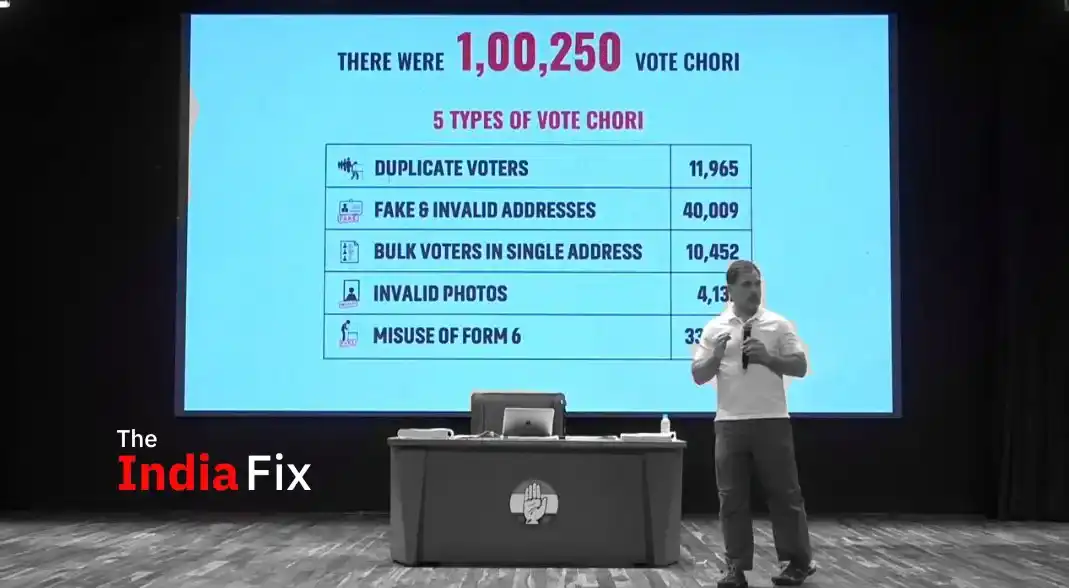
The press conference detailed five types of bogus entries in the electoral roll: duplicate voters, voters with fake addresses, bulk voters with the same address, invalid photographs (which made identification impossible) and enrolling fake first-time voters (using form six).
The examples Gandhi brought up were striking. Gurkirat Singh Dang, for example, appears four times in the roll with the exact same address. Another gent, Aditya Srivastava, votes across the country: Mumbai, Lucknow and in two booths in Bengaluru. One address in Bengaluru, a single-room house, has 80 voters registered to it. Other voters have strings of gibberish for address and father’s name (one was a Mr dfojgaidf). A 70-year-old lady called Shakun Rani enrolled as a new voter, resulting in her being able to vote twice.
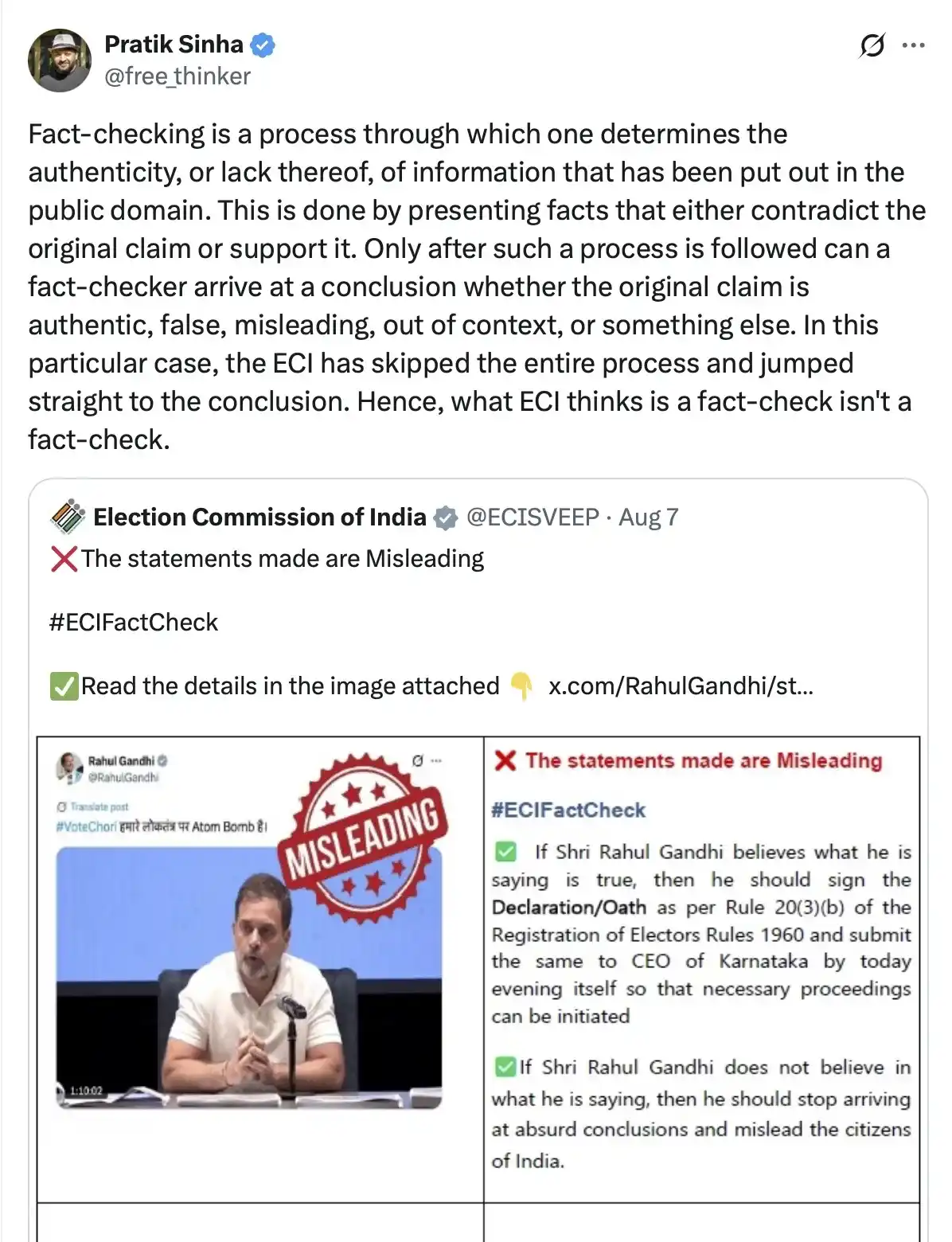
As striking as these examples were, even worse was the Election Commission’s response – or lack of it. It put out a tweet a few hours after Gandhi’s press conference with the tag #ECIFactCheck. Except there was no fact check: it did not actually rebut Gandhi. In fact, it said it would only take action if Gandhi swore an oath. It is unclear why the Election Commission does not think that errors in the voter roll deserve urgent action. Or why it has not agreed to demands by the Opposition to provide machine-readable voter rolls, which would make identifying errors a cinch.
Rising doubts
The Election Commission’s non-response was doubly troubling given this is not the first time doubts have been expressed over the health of India’s voter rolls.
Reporting by Scroll has found multiple complaints against voter roll exclusions. In 2023, the India Fix broke down a detailed research paper flagged multiple statistical anomalies with the 2019 Lok Sabha elections, part of which could be traced back to allegations that rolls were rigged.
In March, the Trinamool Congress flagged that Election Photo Identity Card numbers used in voter cards were not unique. Different voters across the country somehow had the same number. Again, the Election Commission was unable to explain the error even as it said that it would fix it going forward.
Even as the Election Commission is unable to explain how these errors are appearing, it is not holding back from even more drastic changes in voter lists. At present it is conducting a so-called Special Intensive Revision in Bihar with indications that women and Muslims are being especially targeted for exclusion. The design of the SIR, a de facto citizenship test with massive powers in the hands of the lower bureaucracy, makes it highly amenable to political pressure.
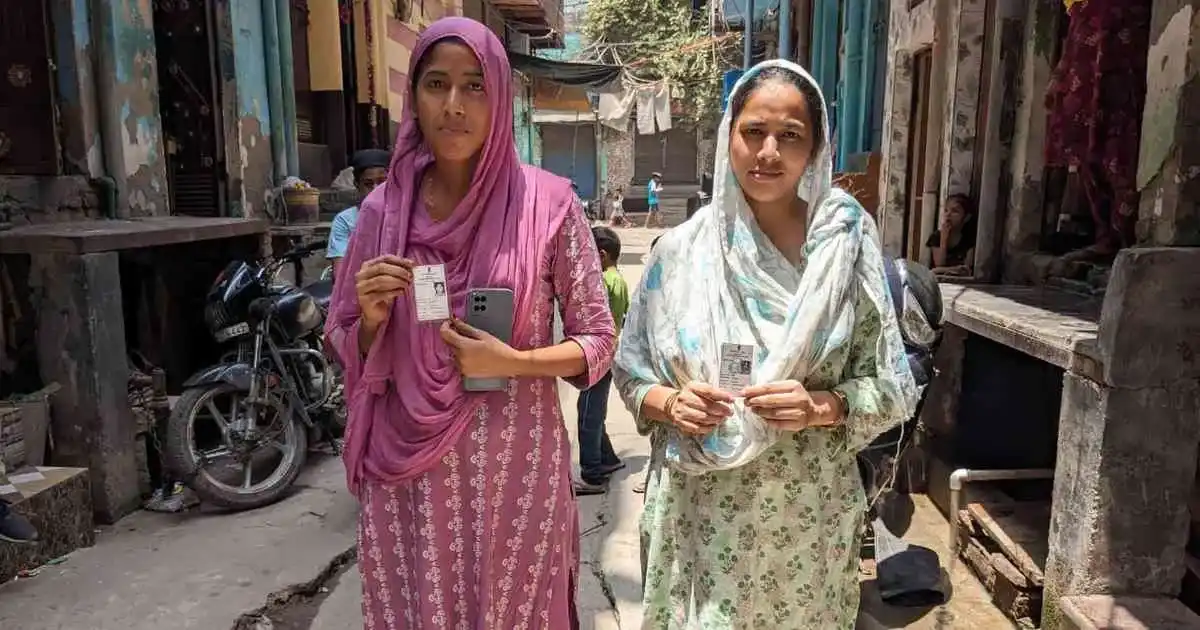
Muslims voters in Delhi whose names have been deleted from the electoral roll. Credit: Abhik Deb
Betraying a legacy
Widespread doubts over voter rolls at the present moment stand in stark contrast to how universal adult franchise was introduced in India: the creation of a voter roll including all Indian voters was one of the first administrative tasks taken by independent India.
India had had elections under the Raj. But they were limited to elites. In 1937, the Raj’s biggest election ever, with Indians electing state governments, saw around a sixth of Indian adults qualify to be voters.
Within a few months of independence, the Constituent Assembly Secretariat, headed by bureaucrat BN Rau, was drawing up new rolls based on universal adult franchise. The political will for this was solid: the Congress had been asking for the vote for all adult Indians since 1928.
The result was, as Ornit Shani points out in her remarkable research on independent India’s first electoral roll, Indians became voters first and then citizens. Rolls were drawn up before the Indian constitution was drafted and adopted. “An electoral roll on the basis of universal franchise prepared and maintained as accurately and up-to-date as possible, was the plinth upon which the institutions of electoral democracy would rest,” Shani writes.
Unsurprisingly, this was a major factor for the Constituent Assembly as well. While moving an article which would lead to the formation of the Election Commission, BR Ambedkar, chairman of the drafting committee, was clear that no Indian should be excluded from the rolls “on the whim of an officer”.
Elections are the guts of a democracy. And voter rolls, in turn, are the guts of an election. Seven decades later, the widespread impression that the whims of officers – and politicians – are now deciding voter rolls is severely damaging to the idea of Indian democracy.
Source: https://tinyurl.com/yhrzv2vb